

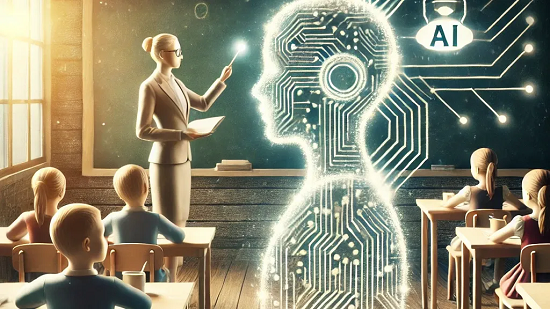
Education today includes new technologies, particularly artificial intelligence (AI). Some examples include AI’s ability to make complex concepts easier for students to understand and assistance to educators in creating lesson plans and other forms of support. Like all technology, however, we must use AI responsibly. To do so, we must ensure that AI does not hinder our students’ abilities to think critically, be creative, or maintain their integrity as scholars. When educators know how to utilize AI appropriately, they will allow their students to experience the benefits of AI while protecting against the most common pitfalls associated with AI.
Table of Contents
Role of AI in Education
There are numerous ways AI tools can help in the classroom. Examples include using AI to explain complex subjects to students, generate study guides, and/or practice writing. Educators can also use AI tools for grading assistance, content development, and/or developing customized learning plans for each student. AI can reduce instructional time spent by educators, therefore increasing instructional time for important and relevant learning experiences.
While there are many positive aspects of utilizing AI in education, AI should never be utilized as a shortcut for educator or student efforts. Learning is comprised of thinking, practicing, and reflecting. Therefore, AI will function best as a supporting mechanism for real comprehension and not a replacement for learning itself.
Principles of Responsible Usage
Responsible usage of AI in education entails being ethical, equitable, and supportive of learning. A key element of responsible usage is honesty. Proper usage includes having adequate instruction and being aware of the limitations of the tool. Individuals who use AI tools must realize that AI is not infallible and must not be relied upon exclusively.
Educators and students alike must see AI tools as resources that should be verified and not treated as authorities. Verification of information and independent thought processes will always need to be primary components in education.
Importance of Being Responsible
Misuse of AI could potentially produce various negative results. For instance, students may over-rely on AI-created responses as opposed to developing their own responses. Both critical thinking and overall learning potential will suffer due to this reliance on AI. Misuse of AI may also result in educational dishonesty (e.g., submitting AI-created work as one’s own).
Teachers are also at risk when they completely rely on AI-created materials without verifying the materials themselves. Incorrect/biased materials can negatively impact teacher effectiveness and student understanding. Proper usage will protect educators and students from these types of issues and ensure that AI will remain a resourceful aid to educators.
Recommendations for Student Use:
1. Utilize AI as a Supportive Tool
Students should view AI as a supportive tool for their studies and not as a replacement for those studies. For example, an AI tool may be able to explain a mathematical concept or summarize a chapter in a textbook; however, students should be expected to have practiced/understand the concept independently.
2. Validate Data
While AI tools can offer immediate and seemingly accurate answers, the data offered by AI tools has been known to contain inaccuracies/outdated information. Before incorporating the data into schoolwork, students should validate the data through reference to credible sources (textbooks, reliable internet sites, or instructors).
3. Avoid Plagiarizing
Students should never submit an AI-created response as their own response. This would be considered academically dishonest. Rather than using AI for generating content, students should generate their own responses, utilizing AI as an aid/guide during the process.
4. Create Quality Inquiry Questions
The quality of responses provided by AI tools is directly related to the clarity and specificity of inquiry questions posed. By creating thoughtful/inquiry-based questions, students will receive responses that facilitate effective learning.
5. Cultivate Independent Thought
Although AI can provide rapid access to information/knowledge, students should spend sufficient time analyzing and understanding the information/knowledge. Developing this type of analytical skill will enable students to develop a greater depth of knowledge and problem-solving ability.
Recommendations for Teacher Use:
1. Establish Clear Guidelines
Teachers must establish clear guidelines relative to the utilization of AI tools for completing classroom assignments and projects. Establishing guidelines will serve to educate students regarding what constitutes acceptable utilization of AI and avoid potential misuses.
2. Foster Openness & Transparency
Teachers should foster openness/transparency regarding whether or not an individual student utilizes an AI tool. Fostering this level of openness/transparency will build credibility among students relative to maintaining academic integrity.
3. Review All AI-Created Materials
Regardless of whether or not teachers assign an assignment/project generated via an AI tool, teachers must review each piece of AI-created material prior to incorporating it into the curriculum or lessons. This allows teachers to verify the accuracy/relevance of the materials.
4. Focus on Developing Skills
Although AI can support teachers with regard to creating curriculum/lessons, ultimately, teachers must focus on providing opportunities for students to demonstrate creativity/discussion/and independent thinking.
5. Remain Current
As technology continues to evolve rapidly, teachers must continue to learn about current AI tools available, their functionality, and limitations relative to their potential application within the classroom.
Consideration Relative to Ethics in the Application of AI Tools:
In addition to functionality, ethics is also a significant consideration in the responsible application of AI tools in education. Teachers/students must consider the principles of equity/fairness/privacy/honesty when utilizing AI tools. Users must also recognize that AI applications will occasionally represent bias based on the data used in training.
Therefore, users must apply ethics by respecting intellectual property rights; avoiding shortcuts; and ensuring that technology enhances authentic learning, as opposed to replacing it.
Balancing Educational Technology with Human Efforts:
Although technology is helpful, it will never replace human emotion/capability/judgment in education. Education encompasses far more than simply receiving correct answers; it encompasses the development of skills/values/understanding.
An optimal balance exists where educators combine technological support with human effort. An example includes a student using technology to collect ideas but still creating original work.
In addition to the above examples, there are countless other ways to demonstrate responsible use.
For example, a high school student could use an Artificial Intelligence (AI) tool to research a topic he/she is interested in and then use that knowledge to write a paper. This would allow him/her to develop his/her own thoughts based on what they found out about their subject area. The same thing applies to a college-level course. A student could also use AI to help with grammar, spelling, etc., before turning in a final draft.
Another way is by allowing students to take tests online instead of having to come into school. This helps save students time, gas money, etc., and gives them one less thing to worry about.
Additionally, a professor could use AI to assist her/him with grading papers. For instance, if a professor has 100+ papers to grade, she/he could have AI read each paper, and then she/he can review each paper. This would give the professor some extra time to focus on other aspects of being a professor, such as teaching the class, etc.
These are just a few examples of responsible use in a classroom setting. There are countless other ways as well.
There are several challenges associated with the use of artificial intelligence in education. One major issue with AI is its potential for producing inaccurate results. Additionally, AI often lacks the ability to provide enough background information when answering a question. Finally, AI does not always have the ability to understand the complexities of human emotion. All these issues limit the amount of trust we can put in AI.


