What are the differences between online education and traditional classroom learning?

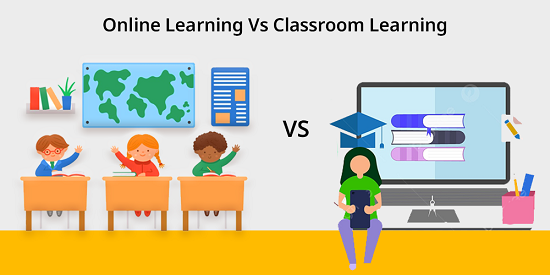
Recently, education has become much more modernized. Now you can get educated almost anywhere, as long as you are connected to the internet. Because of this transition, we have all heard “online education” vs. “traditional classroom education,” and which one is the superior way of getting an education?
Neither is the correct response. Both ways of receiving education have advantages and disadvantages, and the better form of education will ultimately depend on what your needs are, your goals, and your situation.
Table of Contents
What does online education mean?
Online education is when a student receives education via a digital platform. When a student attends classes, completes assignments, and interacts with his/her teacher through the internet, he/she is participating in online education. Online education can occur either live (live lessons) or self-paced (anytime access to recorded lesson material).
Benefits of online Education
There are many benefits to taking part in online education. One of the greatest benefits is flexibility. The ability to study at home, at school, or wherever you want allows students to study when and how they want to. Also, this flexibility is beneficial for students who have families, jobs, etc., that keep them busy throughout the day/week/month. For example, a working parent could take a class after they go home from work each night and does not need to travel across town.
Another great benefit is accessibility. Students can take classes from schools and universities all over the world and never even leave their house. This provides opportunities for students in remote areas and/or students who would not be able to relocate to pursue higher education.
Finally, online education helps foster self-organization and self-regulation. Due to the fact that students will rarely have a teacher standing above them watching them, students must organize themselves to meet deadlines and make sure they get everything done.
Drawbacks to online Education
Although there are several benefits associated with online education, it is not perfect. One of the largest drawbacks is the absence of face-to-face interaction. Students may feel lonely/removed from society and may find it hard to develop connections with fellow students and teachers.
Also, technical difficulties may limit students’ participation in online education. In order to participate in online education successfully, students must have reliable internet access and a device capable of connecting to the internet.
Some students also find it difficult to remain motivated while pursuing online education. Online education lacks structure; therefore, students may easily fall into procrastination mode and lose focus.
Understanding Traditional Education
Traditional education occurs within the walls of a physical classroom where students and teachers communicate directly with each other in person. This has been the norm in American education for centuries.
Benefits of Traditional Education
Perhaps the most obvious benefit of traditional education is direct contact. When a student asks a question during a lecture, participates in class discussion, and receives instant feedback from his/her teacher, he/she develops a greater comprehension of subject matter than he/she likely would by reading books and listening to audio recordings.
A second benefit of traditional education is creating routines and developing habits of discipline. Attending classes at set times every week creates consistency in a student’s academic pursuits.
Lastly, traditional education offers the opportunity for socialization. Students interact with their peers, collaborate on group projects together, and improve their communication skills – all of which are vital skills in everyday life.
Disadvantages of Traditional Education
Traditional education has its limitations as well. Perhaps the most significant limitation is inflexibility. Students must arrive at their designated campus location at established hours, thus limiting the options for busy professionals or parents with children.
Secondly, traditional education can be costly. Expenses related to traveling back and forth to campus, living accommodations near campus, and physical textbooks and supplies are added expenses.
Thirdly, due to a rigid schedule, students may feel as though they are being held back if they do not understand concepts quickly enough; while on the flip side, some students may feel as though the instructor moves too slowly.
Comparison of efficacy
Both formats can lead to excellent results if implemented properly. Research and experience suggest that learning outcomes depend more upon the amount of effort put forth by the learner rather than whether they chose the online format or the traditional format.
Online education typically works well for individuals who are self-motivated and comfortable with technology. Additionally, online education is particularly useful for theoretical subjects or skill-based courses such as coding, writing, or digital marketing.
On the other hand, traditional education is generally ideal for courses requiring hands-on activity or close supervision, such as laboratory science or technical training.
Is there a better way?
Unfortunately, there is no universal answer. Ultimately, the decision will depend on individual preferences, including:
Learning style: Some people learn better in an interactive setting, whereas others prefer to learn independently.
Schedule: Individuals with hectic schedules may appreciate the flexibility afforded by online learning.
Accessibility: Access to computers and reliable high-speed internet greatly influences success in an online learning program.
Course type: courses that involve extensive hands-on practice may require attendance in a classroom.
More often than not, utilizing a blended model, combining online educational resources with in-classroom interactions, affords the advantages of both models. For example, students may view video lectures online and then attend in-class discussions and lab activities in person.
Practical example
Consider a university business major. That major could attend lecture classes to interact with their professor/instructor and classmates in person but utilize an online platform for additional resource access, viewing pre-recorded lectures, completing assignments, etc. Using this hybrid method maximizes both comfort/convenience while also increasing overall comprehension.
Using similar logic, a professional wishing to acquire graphic design skills may prefer online courses so she/he can work at her/his own pace while still having access to expert assistance.
To conclude, traditional and online learning have the ability to give students many different advantages. Traditional learning provides students with a structured environment that has opportunities for socialization and face-to-face contact, whereas online learning allows students to be independent and flexible and access course material at any time from anywhere. There are no “better” options for learning in this context. The type of education that will serve an individual best is dependent upon his/her needs, interests, objectives, etc. A combination or balance of both types of education is probably going to provide students with the greatest number of choices and the most opportunity to achieve their desired goals.